

AI Shopping Agents are Changing the Requirements for Product Information
The current discussion about AI shopping agents focuses primarily on the question of what role shops, marketplaces, and large retail platforms will continue to play in the future.
The Manager Magazin article “Attack of the Agents – AI Alarm at Zalando, Amazon, and Otto” describes how AI systems could take over product search, comparison, recommendation, and potentially the purchase itself. Even established retail platforms are faced with the question of whether direct access to the customer will be partially controlled by overarching AI systems in the future.
For manufacturers and retailers, however, an even more fundamental question arises:
Can an AI system sufficiently understand, compare, and correctly recommend the products offered?
Before a shopping agent can select a product, it requires reliable product information. This includes not only product names, texts, and technical data, but also variants, images, prices, availability, product feeds, and visual product data.

AI shopping agents require product information that is not only discoverable but also clearly understandable.
Product Selection May Begin Before the Shop
In traditional e-commerce, the product detail page is the central location for the purchasing decision.
There, product images, descriptions, variants, prices, and availability appear in a controlled context. Customers can evaluate the information themselves and partially supplement missing connections from the page design or their own knowledge.
AI shopping agents change this logic.
They can merge information from shops, marketplaces, product feeds, search systems, and databases. In doing so, a decision can be made even before visiting a product page as to which products are even eligible for a recommendation.
This changes digital visibility.
A product is not visible simply because it is listed in a shop or found via a search engine. It must also be able to be clearly categorized.
An AI system must recognize, for example:
- which specific product is meant,
- which variant is being offered,
- which properties are relevant,
- which image belongs to which version,
- whether price and availability are up to date,
- and how the product differs from alternatives.
This development affects traditional search engine optimization as much as GEO, generative search systems, and AI shopping. Technical discoverability remains important. However, it is supplemented by a second requirement: the digital understandability of the product.
A Good Product Image Alone is No Longer Enough
Product images remain a central component of the purchasing decision.
They show shape, color, material, proportion, workmanship, and important details. Much of this information can only be replaced to a limited extent by text and technical data.
However, a single image does not automatically explain to a digital system:
- which product is being displayed,
- whether it is a main image or a detailed shot,
- which color or variant is depicted,
- which product properties are associated with it,
- or whether the image still corresponds to the current product status.
The value of a product image is therefore increasingly derived from its data context.
A high-quality image becomes particularly valuable when it is clearly linked to the product number, the depicted variant, a defined image role, the product feed, and the product detail page.
This transforms a simple collection of images into structured visual product information.
This exact connection is also relevant for GEO. Product images should not only be visually and technically optimized. They must be integrated into a traceable context of product data, variants, image series, structured markup, and feeds. The Scanmotion Whitepaper WP-2026-002 describes this development from isolated product images to structured visual product information.

Only the combination of product identity, attributes, variants, images, and availability creates a reliable foundation for shopping systems.
Product Data and Product Images Must be Planned Together
In many companies, product data and product media are still created in separate processes.
Product information is maintained in the ERP, PIM, or shop system. Product images are produced separately. Product videos, 360-degree views, 3D models, and AI content often follow as additional individual projects.
This separation can lead to inconsistencies.
A variant image might show the correct color but be assigned to the wrong article number. A detailed shot shows an important material property without being labeled as a detail image. A product description mentions features that are missing from the product feed.
Humans can compensate for some of these discrepancies. Automated systems are more heavily dependent on consistent data relationships.
Therefore, product information and product media should not only be merged at the time of publication in the shop. Coordination should begin as early as the planning and production stages.
This includes, among other things:
- a clear product and variant logic,
- defined image roles,
- consistent product designations,
- structured attributes,
- matching image series,
- up-to-date prices and availability,
- as well as identical assignments in the shop, feed, and marketplace.
This makes product media production a component of the product data strategy.
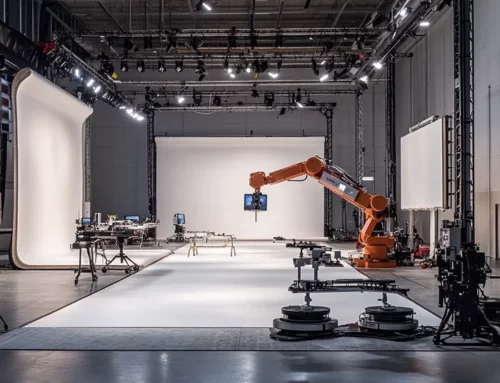
360-Degree Product Photography Can Deliver More Than Just a Viewer
A 360-degree product view is often only seen as an interactive display.
Customers can rotate the product and view it from different directions. This improves spatial assessment and conveys more information than a single shot.
However, the underlying production can achieve significantly more.
A systematically planned 360-degree shoot creates an ordered sequence of individual images from different perspectives. From this, for example, the following can be created:
- interactive 360-degree product views,
- main and side images,
- additional marketplace views,
- detail crops,
- image series for product comparisons,
- source material for product videos,
- social media formats,
- and reference material for future AI content.
The 360-degree view is thus one possible output. The ordered image series forms the reusable foundation.
Especially for larger assortments, this approach can help generate more product media from a single production while simultaneously building a consistent visual product logic.
This corresponds to the basic idea of reusable visual product data: not only is the individual end medium valuable, but also the foundation from which different representations can arise.

Interactive views, individual images, details, videos, and other product media can be created from an ordered 360-degree production.
3D Product Data Expands the Visual Foundation
Not every product requires a 3D model.
However, for products that require explanation, are spatially complex, or are configurable, 3D product data can provide additional information.
This includes:
- spatial form,
- proportions,
- dimensions,
- freely selectable perspectives,
- material assignments,
- technical details,
- AR representations,
- animations,
- and future product visualizations.
A 3D dataset is therefore not just a single media format. It can become the foundation for various digital applications.
The connection with product identity, variants, and structured product information is also crucial here. A technically good 3D model unfolds its greatest benefit when it is clearly defined which product, which version, and which materials it represents.
AI Product Images Require Reliable Source Data
AI product images and AI product videos open up new possibilities for campaigns, application scenes, international markets, and different platform formats.
However, the quality and product fidelity of this content depend heavily on the source data.
If a product is only available from a few inconsistent views, the shape, material, color, or details in generated representations may deviate. The result may look visually attractive without reliably reflecting the real product.
Better foundations are created through:
- consistent product images,
- multiple clearly defined perspectives,
- unique variants,
- visible material details,
- ordered 360-degree image series,
- or suitable 3D product data.
The better a product is captured at the beginning, the more controlled the subsequent AI content can be created from it.
AI should therefore not only be seen as a tool for the rapid generation of individual images. It can become part of scalable product communication if it is built on reliable visual product data.
What Companies Should Specifically Check Now
No one can reliably predict today how quickly AI shopping agents will establish themselves in retail.
It is also unclear which platforms will permanently control access to the customer. Companies therefore do not have to follow every announced system immediately.
However, they can build their product information in such a way that it becomes more usable independently of individual platforms.
1. Product Identity
Are article numbers, GTINs, manufacturer information, and product designations unique and consistent across all systems?
2. Variant Logic
Are colors, sizes, materials, and features correctly linked to images, prices, and availability?
3. Structured Attributes
Are important product properties available as evaluable data or exclusively within longer description texts?
4. Image Assignment
Is it clearly recognizable which image shows the main product, a variant, a detail, or an application?
5. Product Feeds
Do the product page, feed, product designation, price, availability, and image references match each other?
6. Visual Completeness
Are shape, material, details, size effect, and differences between variants sufficiently visible?
7. Reusability
Can existing product images, 360-degree shots, or 3D data be used for further media, platforms, and future AI applications?
These checks do not only serve as preparation for Agentic Commerce.
They can already improve the quality of shops, marketplaces, Google Shopping, image searches, product feeds, and internal content processes today.
AI-Commerce Readiness Begins with the Products
Many companies start the topic of AI commerce by looking for a new tool.
The more important question is often:
Are our products already described and represented digitally in such a way that modern systems can work with them reliably?
This is exactly where the Scanmotion AI Commerce Readiness Check comes in.
The following are checked, among others:
- product images and perspectives,
- variants and color assignment,
- material and detail representation,
- size effect,
- 360-degree and product video,
- reusability of media,
- structured product information,
- feed and shop consistency,
- as well as general suitability for modern shopping and AI systems.
The result shows which foundations are already in place and where specific improvements are sensible.
Conclusion
AI shopping agents are not only changing shops and purchasing processes.
They are changing the requirements for product information.
Product data, variants, images, feeds, 360-degree views, 3D product data, and AI content should therefore no longer be planned independently of one another.
The crucial question is not just which shopping agents will prevail.
The more important question for companies is:
Is our product already so understandable digitally that humans and AI systems can categorize it correctly?
Many Digital Outputs Can Arise from One Product Production
Scanmotion creates product images, 360-degree product views, 3D product images, AI product images, and AI product videos based on reusable visual foundations.
This allows product media to be more consistent, scalable, and better prepared for shops, marketplaces, and new commerce systems.
AI shopping agents assist users with product searches, comparisons, and selection. Depending on the system, they can capture requirements, evaluate products from various sources, provide recommendations, and handle further steps in the purchasing process.
Agentic Commerce refers to shopping scenarios in which AI systems independently handle tasks within the purchasing process. This can include product searches, comparisons, consultations, selections, price checks, or transaction processing.
AI systems require clear information about product, variant, features, price, availability, and media. The more consistently this information is linked together, the better a product can be classified and compared.
Modern AI systems can evaluate visible features from product images. However, an image alone does not reliably explain which specific product or variant is being displayed. For this, a connection with structured product information is necessary.
In addition to the interactive view, a 360-degree production can deliver numerous ordered individual images. These can be reused for shops, marketplaces, detail views, product videos, social media, and future AI applications.
No. Whether 3D product data makes sense depends on the product and the intended applications. They can be particularly valuable for spatially complex, configurable, or products that require explanation.
In this context, GEO stands for the optimization of content for generative search and response systems. For product images, this concerns not only the visible image quality, but also the connection with product data, variants, image roles, structured markup, and product feeds.
The check examines, among other things, product images, perspectives, variants, material representation, scale effect, 360-degree views, product video, reusability, and the connection between visual media and structured product information.